New Zealand March/April 2002
New Zealand is a very long
way from the United Kingdom! The flight was around 27 hours, and we arrived i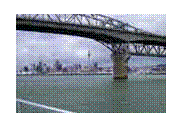 n
Auckland at about 0400 local time. Actually, it was not as bad as we had feared,
and jet lag proved not to be a problem. After catching up on some sleep we
started to explore the city. Nearly a third of New Zealand's population lives in
Auckland—just over 1 million souls. This makes it similar in population to
Bristol (including its environs), but the view from the Sky Tower, where we had
lunch on our first day, shows that the city is spread over a much greater
distance. Thus Auckland has similar problems to most modern cities regarding
traffic congestion and space for building.
As well as exploring down town, we
tool a harbour trip (from where the above photo was taken. Auckland is very
water oriented, with 1 in 3 residents owning a boat. We also saw the Americas
Cup teams moored in the harbour. A course was laid out just further out in the
harbour, and the teams were going out to practice.
 On
our second (full) day in Auckland, we took a day trip to Rotorua and Waitomo
caves. Our man stop in Rotorua was at the thermal reserve called 'Te
Whakarewarewa' for short. It's full name is 'Te Whakarewrewatanga o te Ope Taua
a Wahaio', which means 'The gathering together of the War Party of Wahaio'.
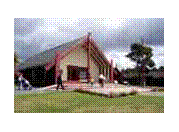
Here there is a replica Maori village, complete with tribal meeting house (see
picture), and the Maori Arts and Crafts Institute, where the traditional arts of
the Maori are taught to the next generation.
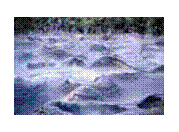
The reserve has both geysers and
bubbling mud pools, and the smell is a little bit noxious. Indeed, you can small
Rotorua long before you can see it.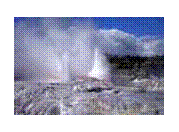
 The geysers a erupting almost continually, and can reach 20 metres on a
occasion. The whole town of Rotorua sits within the cauldron of a vast volcano,
with Lake Rotorua in the centre, and the hills surrounding being the rim of the
crater. The town has evidence of recent eruptions right in its heart, and its
only a matter of time before the inevitable happens.
Waitomo caves, the the west of
Rotorua, were more spectacular than we'd imagined. The limestone caves are
similar to any one might see, but the magnificent cathedral chamber was quite
spectacular, and our guide treated us to a Maori 'serenade' in the hall. The
highlight is the glow worms. Actually the larvae of a type of fly, the glow a
wonderful cyan colour, and the caves with the underground river have thousands
of them, glowing like a galaxy of stars. Needless to say, it was too dark in the
caves for photographs, so you'll just have to imagine. Our final evening in
Auckland was spent with the brothers of Amanda's sister-in-law. We went over for
a barbeque (of course!), and had a really great time.
 On
the Friday (the 29th of March), we took the 'Overlander' train from Auckland to
Wellington. The train takes all day to do the journey, and so it was dark when
we arrived. Our hotel, however, had a great view over the harbour, which looks
 pretty at night. The city is known as the windy city, and it lived up to its
reputation whilst we were there. We didn't have much time in Wellington, but we
met up with the brother of one of Amanda's work friends and his family. We had a
great time with them; climbing Mount Victoria for views over the city, having
lunch in Eastbourne, and being invited into their home. Wellington seems a
lively place; smaller than Auckland but good shops and things to do at night. We
found one place, espressoholics, which was a funky cafe in the day, and a lively
bar at night.
Wellington
was our last stop on the north island, and we caught the Lynx ferry to Picton on
the south island. The Lynx ferry is a catamaran which is faster than the
traditional ferry. 
 However,
since there are speed restrictions in Queen Charlotte sound on the approach to
Picton, it isn't much faster anyway. Fortunately for us the crossing was pretty
smooth. The following day, we saw on the news, ferries were cancelled for a few
days due to rough weather, and many tourists were stranded. Picton owes its
existence to the ferries and has little else. However, when we arrived it was a
lovely sunny day, and the boats in the harbour looked pretty enough. Picton was
just a stop off point for picking up the coach to Kaikoura.
Kaikoura is a small town on the east coast of the south Island between Picton
and Christchurch. 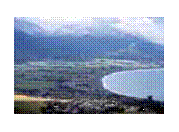 The main reason for its visitor are the Whales which feed of
the coast. A deep trench just of the shore brings the whales in much closer to
shore than they would normally venture, making it an ideal spot to see them.
 We
were staying at the Old Convent, about 3 kilometres from the town. This was a
wonderful place with comfortable rooms in the converted buildings, and wonderful
meals prepared in the evenings (except on Sundays). Being 3km from town was a
bit of a bind as we had no transport, but we were lent the 'courtesy' car—a
dilapidated old Honda, with no speedometer and a dodgy right indicator. But it
got us about, and we would have been stuck without it.
The town has the Kaikoura Seaward range of mountains as a backdrop, though
they were shrouded in cloud for most of the time we were there. In fact the
weather wasn't very kind to us, and we had booked boat trips for both mornings
that we were there. They were both cancelled due to high seas of about 4 metres. 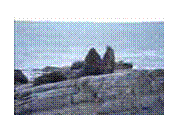 So on the first day, we went to Kaikoura Wines. This is a very new
vineyard. So new in fact that they are not yet producing wine on the
sight, but use fruit from further north in Marlborough. We had a tour in the
wine cave and some tastings. They
 produce a Pinot Noir and a variety of white
wines. The second day had brighter weather, though still not good enough for the
boat trip. So we headed to the airport to see if we could get a flight to spot
the whales from the air. When we arrived they hadn't seen any that morning and
advised us to return in the afternoon. In the meanwhile we drove to Kaikoura
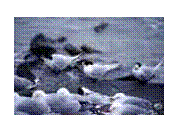
peninsula to see the fur seals. We were lucky and saw some seals right by the
car park, as well as some local sea birds. In the afternoon we returned to the
airport to try our luck once more. Still they hadn't seen a whales, but then the
pilot radioed in to say that they'd spotted one. So we signed up, and headed out
in the islander to see if it could be found again.
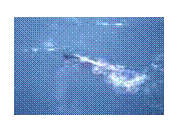 After a little while, and
having flown in to a squall sitting right over the spot where the whale
was last spotted, Amanda caught sight of it.
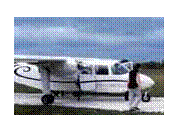 I'm not sure which was more
thrilling, seeing the whales, or flying at 500 feet in a tight circle above a 4m
swell in a rain squall. Photography, as you can imagine in such circumstances,
and so the picture quality is not great.
After Kaikoura we heeded by coach to Christchurch. This
should have been a short journey but the coach blew a tyre quite spectacularly
on the way, and we were stranded for a couple of hours. The stop in Christchurch
was only over night. We stayed at the Chateau on the Park hotel, which was a
really friendly and comfortable place.  They
had a great restaurant with a good wine list of New Zealand wines, and very
friendly young waitresses.
 The next day we headed south again to Queenstown. We
had a choice of coaches; one which went down the coast for most of the way, and
was quicker, or a coach that went via Mount cook, and took much longer. We chose
the latter option, and didn't regret it at all. It was a wonderful sunny day,
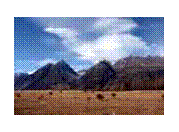
and once we cleared the Canterbury plains, the scenery was spectacular. We
passed many lakes including Lake Tekapo and Lake Pukaki. As we approached Mount
Cook we got sight of the Southern Alps, which are beautiful to grossly
understate it. Mount Cook settlement is little more than a hotel and a few
hostels, with an airstrip for the flights and helicopter rides you can take. But
it was worth going for the view over toward Mount Cook which was fortunately
clear of clouds for us that day.
Queenstown is very small, and not a little touristy. It was wet on the first
day we were there, so we went on a great wine tour. We visited the Gibbston
Valley vineyard, which now also has a cheesery as well as some smaller
vineyards. Of course we tasted lots of wine. The Pinot Noir, which is common all
over New Zealand had amazing variety between vineyards, and even between
vintages from the same vineyard. Also dry Rieslings were a revelation, being
much more palatable to our tastes than the sweet German varieties.
On our second day, the weather cleared allowing us to take a flight to
Milford Sound. The flight over the mountains to Milford was stunning, and
thrilling. We flew in a little Cessna 207 with our pilot and another couple. The
mountains from the air are even more beautiful. Perhaps the most stunning sight
was the Sutherland Falls. A great lake sits high in the mountains, and its
overflow falls 600 metres or more. 
 The
landing at Milford was equally exciting. Coming high over the mountains we say
Milford's air strip thousands of feet below. The aircraft was flown along the
sound and out to sea as we descended. As we left the sound and turned around to
face the airstrip, the winds took hold of the aircraft and shook it more
violently than I have ever experienced. The lady passenger had here eyes tightly
shut and was hanging on for dear life. The pilot assured us all was well.
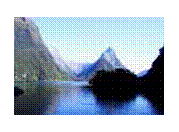
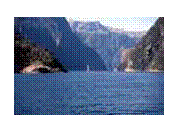
 Milford
Sound is in fact a fjord, having been formed by the actions of glaciers carving
channels out of the mountains. The main way to see the sound is to take a boat
trip, which is just what we did. The was a short delay as our boat's engines
wouldn't start, and we had to transfer to another boat. The first striking
feature as we left the dock is Mitre Peak, so named because of its resemblance
to a bishop's mitre (hat type thing). The walls of the sound have many
waterfalls, some bigger than others. It is said (and we've seen the photographs)
that in stormy conditions, the waterfalls do not reach the sea, but are blown
back up the walls by the sheer force of the wind. This is true even of the
largest of the falls, Stirling falls.
In the evening after Milford we ate at a restaurant just a few kilometres
from Queenstown, at Arthur's point. This was called Gantley's and is reputed to
be the finest restaurant in New Zealand, and amongst the best in the
world. As it wasn't ruinously expensive (though still not cheap) we decided we'd
eat there. Now Gantley's has a wonderful thing called a 'Degustation' (which
sounds like a Victorian ailment). This is a meal of five courses, with selected
New Zealand wine for each course. To cut a long story short, it was wonderful;
one of the best meals we've had, and the wine complemented each course
wonderfully. The restaurant itself was equally lovely, and they have a wine
library in a beautiful dining room just of the main reception area. Needless to
say we didn't eat in there.
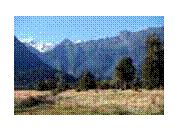
 After Queenstown we headed off for Fox Glacier.
Fox is a small town situated on a single street. Its backdrop is the peaks of
Mount Tasman and Mount Cook, nestled in the Southern Alps. The main reason
people come to Fox and its slightly bigger counterpart Franz Josef, is to see
the glaciers.
The two glaciers are accessible by ski plane, helicopter or, for the
adventurous, hiking with a guide. We chose the easy option and flew in a
helicopter. We'd never been in a chopper before, and we'd chosen a good first
flight as the scenery was breath taking. We'd booked ourselves on the 'do
everything' flight, which took in the peaks of Tasman and Cook, the glaciers of
Tasman, Cook and Franz Josef before finally landing on the top of Franz Josef
glacier.  The
descent from Franz Josef glacier was rapid to say the least, and we had to pop
our ears constantly. We passed many crevasses on the descent, which like like
little creases in the snow and ice, but are in fact very deep, reaching depths
of more than 60 metres. The whole experience took around 45 minutes, though it
seemed even quicker.
As we'd flown to the glaciers early in the morning, we found ourselves back
in Fox by 10am with nothing to do. At Fox Glacier Lodge where we were staying,
we were sharing the lodge with two older couples—one
couple Kiwi and the other English.  They
were called David and Alison, Peter and Diane. They were nothing but kindness to
us, and they discovered us in the main street of Fox like lost souls, and
offered for us to spend the rest of the day with them. So that's what we did,
visiting Lake Matheson some 6km out of town. The lake, on a still clear morning,
has the peaks of Tasman and Cook reflecting in it, but when we were there the
lake wasn't quite still, and the clouds had started to roll in over the
mountains. However, the walk through native fauna was wonderful, and we came
across a pretty blue mushroom on the path. We took a photo of this, but
unfortunately it came out blurred. Then, later on we walked to near the foot of
Franz Josef glacier. After tea in Franz Josef we headed back. Just a couple of
hundred yards from the lodge was a 'glow worm grotto'. Perhaps not as
spectacular as Waitomo Caves, it was none the less fun to traverse the walk way
in pitch black, with the little 'worms' glowing by the side.
Our final journey was to Greymouth via coach, picking up the Tranzalpine
train back to Christchurch. The train runs through the Southern Alps, passing
Arthur's Pass at its highest point. The journey was comfortable, but not as
spectacular as we'd expected. It is probably much better whilst there is still
snow on the hills, and in all the photos one sees this is the case.
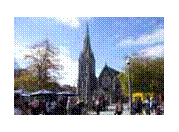
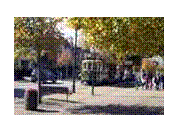 When
we arrived back in Christchurch we stayed in the Chateau on the Park hotel
again. The next day we were due to fly back to the UK, transferring from
Christchurch to Auckland by plane, before returning on the main flight. We had
most of the day to spend in Christchurch, and we explored the Botanical gardens
before walking into town and the main centre, Cathedral Square. We spent most of
the time at the gardens looking for a 'silver fern,' the famous symbol of New
Zealand. We'd seen many in the North Island, and we wanted a photograph of one,
but it took ages before we finally came across a specimen.
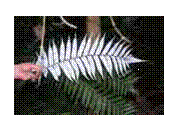 The trouble is all the fens, of which there are many, look similar until you
turn the leaf over to expose the silver underside. The older parts of town have
an 'English' feel to them, and the trees were certainly showing signs of the
autumn season. We visited the museum which has a fine collection of exhibits
from the 'heroic age' of polar exploration, and Lady Scott's statue of her
husband Robert Falcon Scott stand proud on Worcester Street. That afternoon we
headed for the airport, and took the next day and a half to return to our little
house in North Somerset. New Zealand has been one of our best experiences. The
people are the warmest you'll find anywhere, and the country is just beautiful.
We count the days until we return.