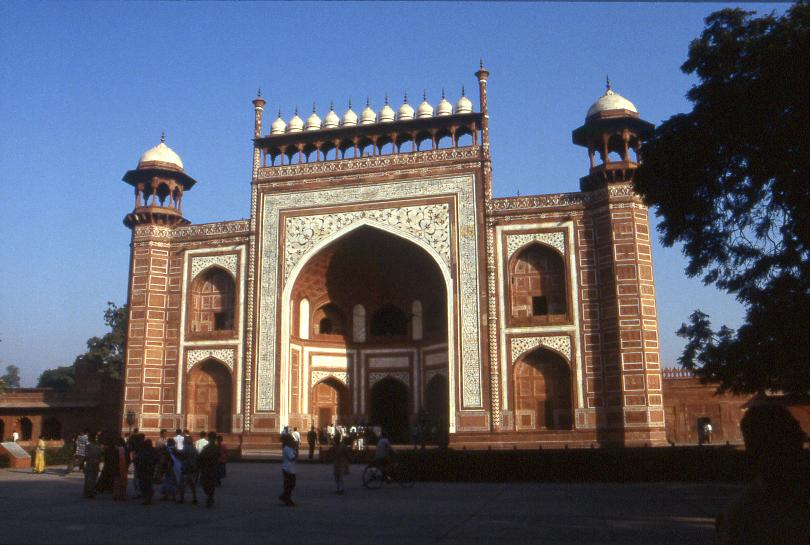
Southern Gateway to the Taj Mahal
The roads to Agra were probably the best we were to see, and the car was certainly up to the job then. This would change with time. Driving in India is insane. There is lots of overtaking, with oncoming lorries baering down. Lots and lots of horn blowing and hard breaking. Quite frankly it is completely scary and you have to have some nerve, even as a passenger.
The trip to Agra gave us a chance to view some of the country side outside of the city. We saw many farming plots, with rice fields, herds of sheep and goats, and also may straw and mud huts, housing the people who work the land. Poor though the country people obviously were, somehow their poverty did not seem so squalid as that of the poorest in Delhi---though I'm sure they would equally welcome a rise in their standard of living. But we were gald to get out of the crowded city.
The hotel in Agra was comfortable, and we relaxed that afternoon. The first activity was not until early next morning, when we were to see the Taj Mahal.
The Taj Mahal is reached by electric car, as vehicles are not allowed
near the monument, to prevent too much pollution staining the white marble.
One enters the complex at the southern end, though there are the Western
and Eastern gates as well.
Southern Gateway to the Taj Mahal
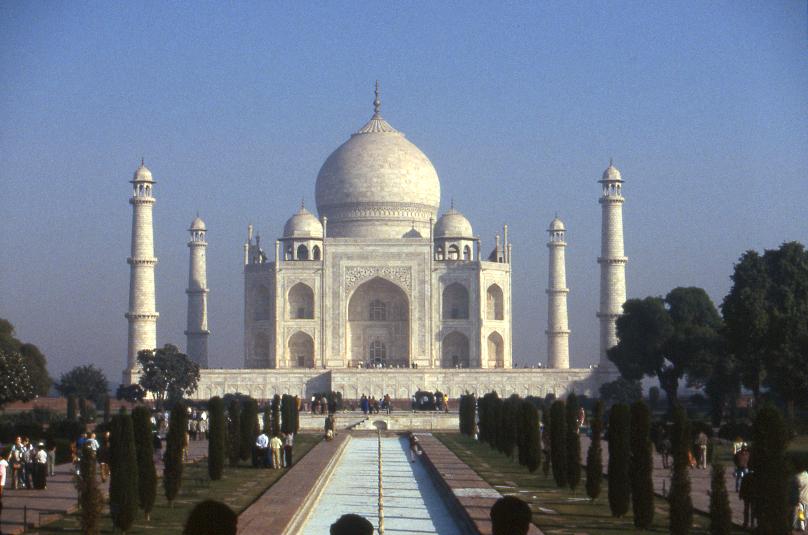 The Taj Mahal |
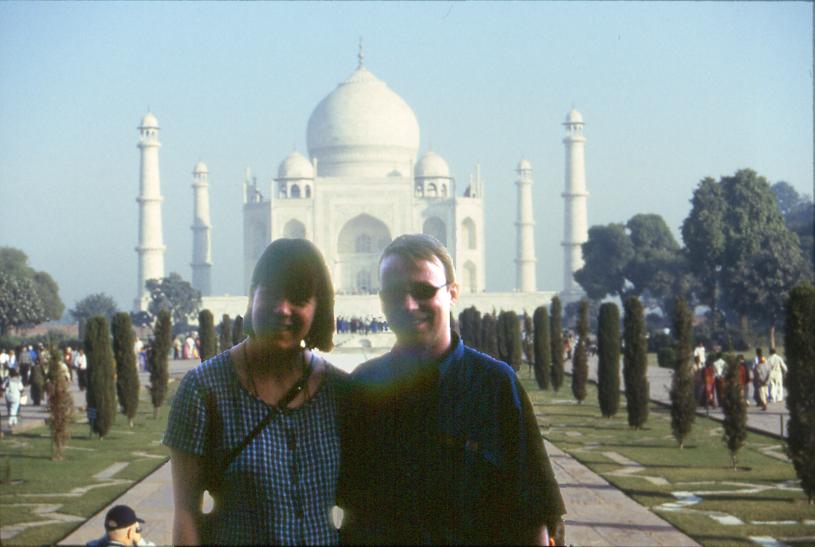 Us at the Taj Mahal |
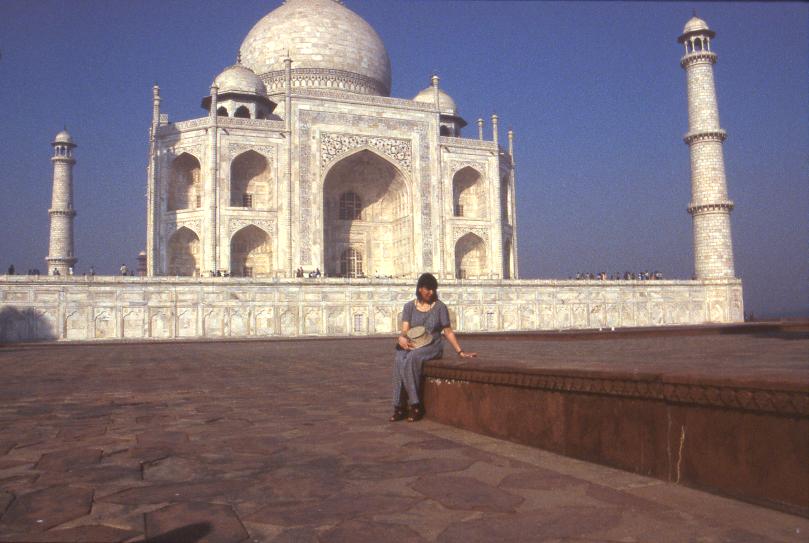 Princess Amanda |
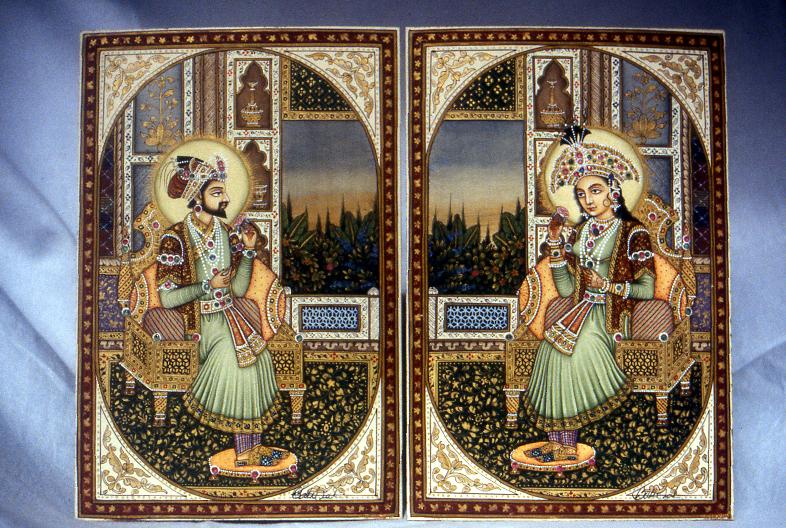
The monument itself is more beautiful than one expects or can imagine. The white marble is so wonderful, and it is decorated with the finest foral designs, abstract patterns, and many passages from the Koran. Inside it is cool, and Shah Jahan's tomb is along side that of his wife's. The monument is a shrine to symmetry. Apart from Shah Jahan's tomb, everything is symmetrical, and the towers in the four corners lean out slightly so that, should they fall, they will not destroy the monument.
Agra was the seat of the great Moghuls for many years, centred at the Agra Fort. The fort at Agra was begun in 1565 by Akbar (Shah Jahan's Grand Father) and added to by subsequent emperors.
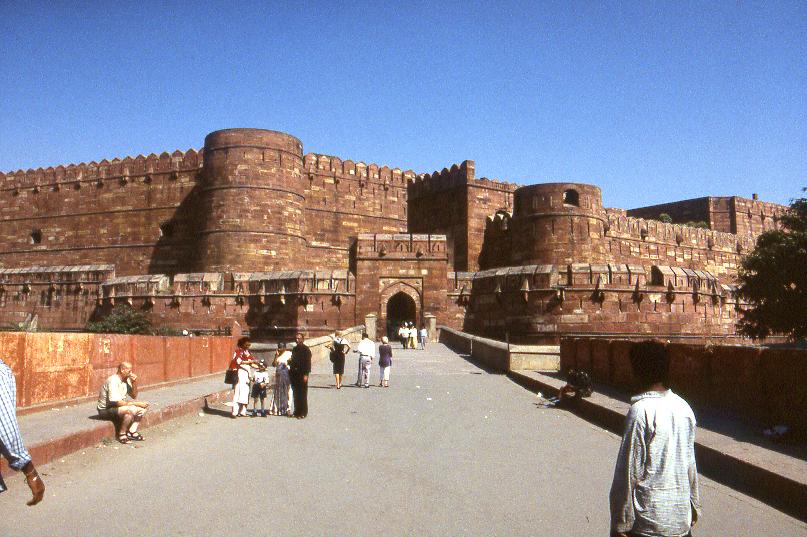 Main Gate, Agra Fort |
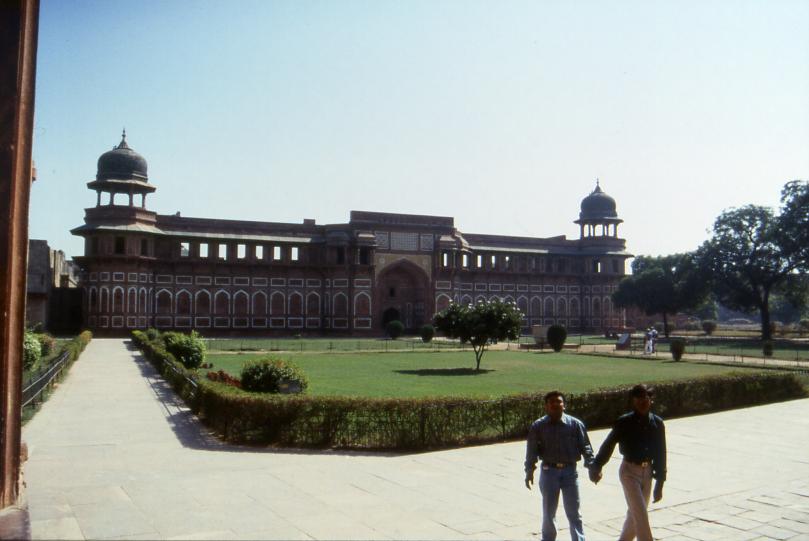 Jahangir's Palace |
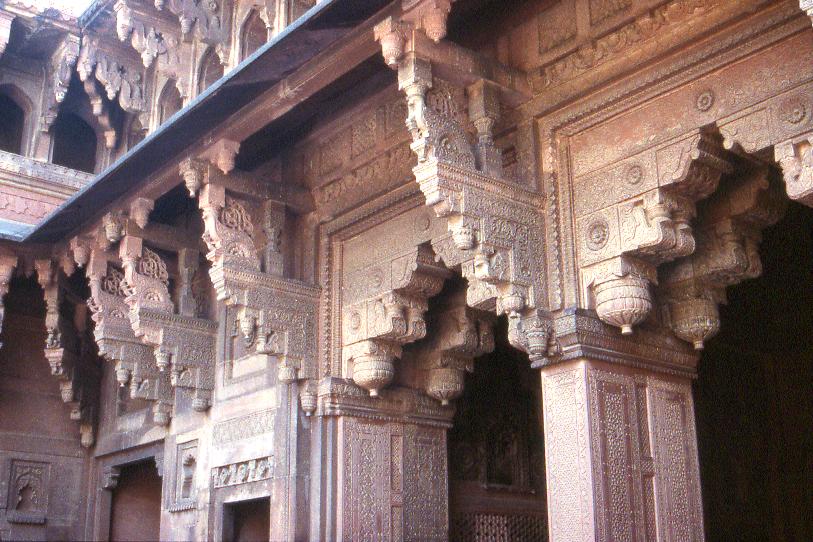 Hindu Detail |
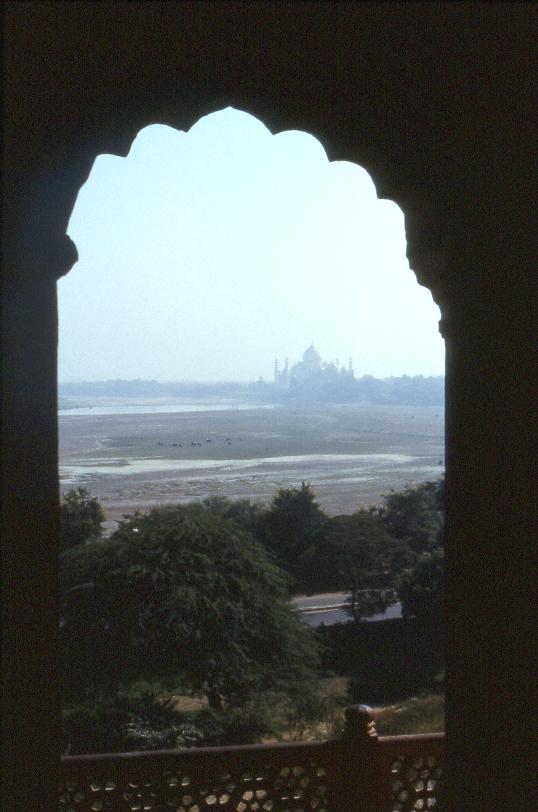 View from Musamman Burj |
Other areas within the fort were built by Shah Jahan. One of the places, Musamman Burj (Octagonal Tower), was where Shah Jahan was imprisoned for 7 years by his third son Aurangzeb, a more zealous and orthodox Muslim, until his death in 1666. From there he had a view of his wife's monument every day for those 7 years.
21st January 2001